Part One · The Orphan's Song
Chapter 2The System Awakens
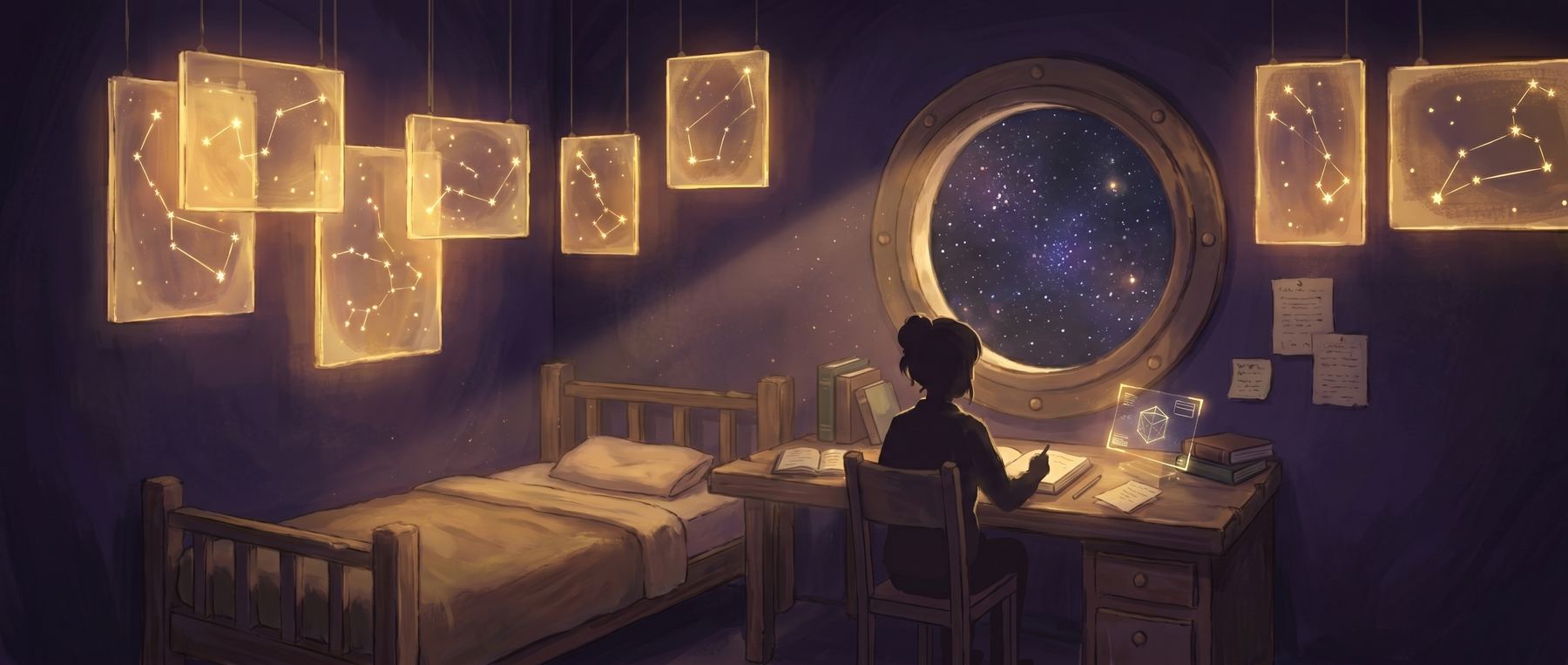
Beacon Seven-Echo was lying.
Kira hung off the relay's service spine in the maintenance saddle, mag-tether humming against her hip, Gauntlet jacked into a diagnostic port older than most of her instructors. She read the beacon's local log a third time, because the first two readings had refused to get better.
The sector notice — the one that had chimed into her cockpit with its tidy 03:17 timestamp — had called it a minor fluctuation. Magnitude 0.003 percent. Auto-corrected. Action required: none.
The beacon kept different books.
Correction events, last 30 days: 4,112
Lattice status reported upstream: NOMINAL
Four thousand corrections. One stumble every ten and a half minutes, around the clock, for a month — a man swearing he was fine while his hand shook on the railing. The lattice out here wasn't steady. It was being steadied, constantly, by tired machines, and every report the machines sent home described the steadying and called it calm.
Auto-corrected didn't mean nothing was wrong. It meant the wrongness was being smoothed over four thousand times a month, and the smoothing was the only part anyone got told about.
She pulled her notebook out of the thigh pocket — paper, graphite, the whole museum-piece ritual — and braced it against the saddle frame.
Beacon 7-E. Corrections 4,112/30d, accelerating. Upstream report: NOMINAL. The network isn't calm. It's medicated.
There was something else, too, and it took her three passes on the comm bands to stop dismissing it. The static out here wasn't static. Underneath the hiss, faint as a pulse through a wall, a figure repeated — five notes, maybe six, always descending, always unfinished. She isolated it twice. Both times the analyzer returned PATTERN: INCONCLUSIVE, which was institutional for we also hear it and decline to say so.
Her chest did the low strange thing it had done in the observatory — one string humming because another had been struck. She made herself breathe until it passed.
Interference on all bands. Repeating descending figure. Not random (?)
She filed the anomaly report through her Gauntlet, formal channels, by the book: correction counts, the acceleration curve, the structured interference, her sworn cadet's signature. The reply arrived before she'd finished unjacking the diagnostic line.
RECEIVED. LOGGED. CONSISTENT WITH KNOWN FRINGE VARIANCE. ACTION REQUIRED: NONE.
Eleven words, four of them the same four from last night. She sat with that a moment, helmet ticking in the beacon's shadow, then stowed the notebook and kicked back toward her shuttle.
The report was filed. The report would be filed forever. Out here, filed and buried were the same drawer.
Her mother's coordinates sat forty minutes off the patrol lane, and the corrections got worse the whole way in.
She'd rigged the shuttle's secondary display to chart correction density off the beacon relays as she flew — her own map, unofficial, drawn in the colors of things going wrong. The patrol lane read amber. The lane toward the coordinates climbed through orange. Whatever the beacons were smoothing over, she was flying up its gradient, straight toward the patch of nothing where two researchers had once gone looking and never come back.
She caught herself checking the long-range returns for hull profiles she'd memorized at seven years old. A survey skiff, Calanthe-class, registry ZV-1141. Twelve years was nothing in vacuum. Metal kept.
What her sensors found instead was wreckage that had no business being new.
The debris field resolved out of the dark a thousand kilometers shy of the coordinates — twisted spars, scorched plating, a slow constellation of ruin turning in Auron's distant light. She cut velocity and threaded into it, running lights doused out of an instinct she didn't bother arguing with. The metal was bright where it caught the light. No oxidation rime. No micrometeorite pitting. This ship had died within the last standard week.
Twelve years too late to be theirs. Her breath came back, and she was ashamed of how much of it was relief and how much was the other thing.
The hull's largest surviving section tumbled slowly at the field's heart — a freighter's midbody, torn open along one side, the wound's edges curled outward like petals. No registry. No transponder. The only marking anywhere on the hull was scorched into a cargo door two meters tall: a triangle, drawn in clean broad strokes and left hollow at the center, the way a child draws a mountain and forgets to fill it in.
She ran it through every recognition index her Gauntlet held. Fleet registries, faction marks, salvage guild blazons, pirate colors going back a century.
NO MATCH.
A symbol nobody owned, burned onto a ship nobody claimed, dead a week, parked on her mother's coordinates. Kira annotated the sketch in her notebook — hollow triangle, approx. 2m, cargo door, orientation point-up — and her hand wanted to circle it. She circled it once. Her mother had circled things three times, and look where that had gone.
The shuttle's comm panel chirped.
Nine percent. A whisper on its last battery, and not a distress call — distress calls said help us. This one said contain. Somebody's alarm, still ringing in a dead house, about something that had gotten out.
Protocol had a clear opinion: log the wreck, hold at distance, request a survey team that would arrive in nine days and find exactly what nine days leaves. She was one unbonded cadet with a maintenance docket and a standing reputation for instability, and boarding an unidentified wreck alone was the kind of line item that ended Academy careers.
She suited up.
It wasn't even a hard decision, which probably belonged in somebody's evaluation of her. There were only two kinds of people: the ones who reported the dark and the ones who went and looked at it. Her whole family was the second kind, and the first kind had spent twelve years filing them under NONE.
The cargo bay had been a place where something patient and methodical was done to living things, and the ship had died around it without making it any less itself.
Kira came through the inboard hatch slow, boots finding the deck, helmet lamp cutting a cone through air that her suit insisted was present and breathable and four degrees above freezing — emergency seals had saved the forward third of the ship. She left the helmet sealed anyway. The lamp found the far wall, and she stopped moving.
Cages. Two ranks of them, floor-bolted, running the bay's full length — eighteen, she counted, because counting was a thing hands and eyes could do while the rest of her caught up. Mesh-fronted, each one barely a meter on a side. Water troughs gone to ice. Scour marks where small bodies had worn the corners smooth, the way a thing wears a space it has stopped believing it will leave.
Most stood empty with their doors hanging open. Open from the outside — latches thrown, neat, unhurried. An evacuation, or a harvest.
Two were not empty. She made herself walk the rank and look, because what you witness, you owe, and somebody owed these two at least the looking. They had been Asterials. They were dim the way a coal is dim — not dark, spent — their patterns guttered down to a gray that her chest read as an ache before her mind found any word for it. The dark between stars at 03:17 had been an ache with a shape. This was the shape, twice, small, in cages. Nothing about it had teeth. That was the worst part. Whatever had been done here hadn't even been cruel the way violence is cruel. It had been cruel the way accounting is.
Every cage bore the same stamped plate at the latch. A hollow triangle, point-up, above a string of digits.
Cage nine's plate read 7-7-091, and cage nine was wrong in the other direction.
Its door hadn't been unlatched. It had been forced — bent outward, mesh stretched and split from the inside, the latch plate sheared and hanging. Whatever had lived in cage nine had not been collected. It had declined.
She crouched. Put her glove against the deck inside the cage door, where her suit's palm sensor could read surface temperature.
Warm.
Not residual-power warm, not warm like machinery. Warm like a bed someone had just left. Hours at most. Maybe less. In a dead ship, in a frozen bay, something had been curled in this cage recently enough to leave its heat behind, and that something had once torn its own door open rather than wait its turn.
One of the latch plates had broken clean off in the forcing and lay in the cage's corner — an alloy chit the size of her thumb, stamped triangle and digits, snapped at the bolt holes. Survey protocol on a presumptive crime scene was absolute: document, disturb nothing, leave everything for the team that would never come.
Kira looked at the chit for a long three seconds. Then she picked it up and zipped it into her thigh pocket, and wrote the theft down, because a falsified record was the one thing she refused to keep.
Removed: latch plate, cage 9, stamp 7-7-091. Protocol violation, mine, freely chosen. Somebody has to carry the receipt out of here.
She was still crouched there, hand flat on the warm deck, when the static stopped.
She didn't understand at first what had gone missing, because she had never once been without it.
Sixteen years of it: the fizz at the edge of vision, the gray pressure behind the eyes, the error cascade crouched and waiting every time her attention brushed her own status — her whole life conducted over the sound of a detuned channel, so constant it had stopped being sound. It cut out the way a ship's air recycler cuts out. You never knew it was roaring until the silence hit you like a held breath releasing.
Her vision cleared. Not improved — cleared, rinsed, the cargo bay's dim geometry suddenly carved and exact, every cage edge a clean line. Something vast and patient turned its attention toward her, the way the dark between stars had turned, except this wasn't the dark. This was warm. This was the feeling of a door that had been locked her whole life going quietly unlocked — not opening yet. Unlocking.
A box assembled itself across her sight, and it was the box, the one she'd dismissed a thousand times, the oldest fixture of her life — with the wrong words in it.
Stand by.
Kira knelt in a dead ship's cargo hold and read four lines of System text through a blur she couldn't blink away.
Listening. Sixteen years of INACCESSIBLE, sixteen years of report-to-Medical, sixteen years of a sense that opened for everyone in the sector except her — and the word it chose, here, in the dark, beside a torn-open cage, was listening. Not broken. Not unstable, whatever the header still claimed. A channel nobody had called on, picking up at last, saying: this number is in service. Stand by.
Recognized. Recognized meant known. Recognized meant there was a dialect, and she spoke it, and somewhere there existed whatever it was a dialect of.
Her body got the news before her thoughts did. The unclenching ran down her spine like warm water, muscles letting go of a brace she'd held so long it had become posture; her back teeth registered a hum, faint and clean, like a struck glass settling. She was crying inside a sealed helmet, which the suit logged as a humidity fault, and laughing at the suit for it, both at once, kneeling on the warm spot where a frightened something had recently been.
Then the static came back.
Soft at first, then the whole gray roar of it, the box dissolving into the old familiar garbage cascade — RECALIBRATING flickering to CALIBRATION REQUIRED and down into noise. The bay went back to being dim. Her edges went back to being approximate. The channel had picked up, said stand by, and set the receiver gently down.
She stayed kneeling. Her hand had never left the warm deck, and she worked through it the way she worked through everything, in field notes, because the alternative was hope and hope had no margins to write in.
The silence had begun at this cage. The deck was warm. The System had recognized a dialect with whatever-had-slept-here close by, and lost the thread as the warmth under her glove faded. Conclusion, marked with the cowardice of a question mark and underlined with the certainty of a straight edge: the dialect isn't only mine.
Somewhere deep in the wreck, forward, toward the whisper of the dying beacon, came a sound her exterior pickups swore was real. Soft. Liquid. The sound of water moving through a ship that had none — one trickling note, descending, and then nothing at all.
Kira rose, killed her helmet lamp to a hand's-width glow, and went forward to find out what had been worth caging.
✦ Chapter woven into the thread ✦
Next — Chapter 3: The Frightened Droplet