Part One · The Orphan's Song
Chapter 13The Semi-Finals
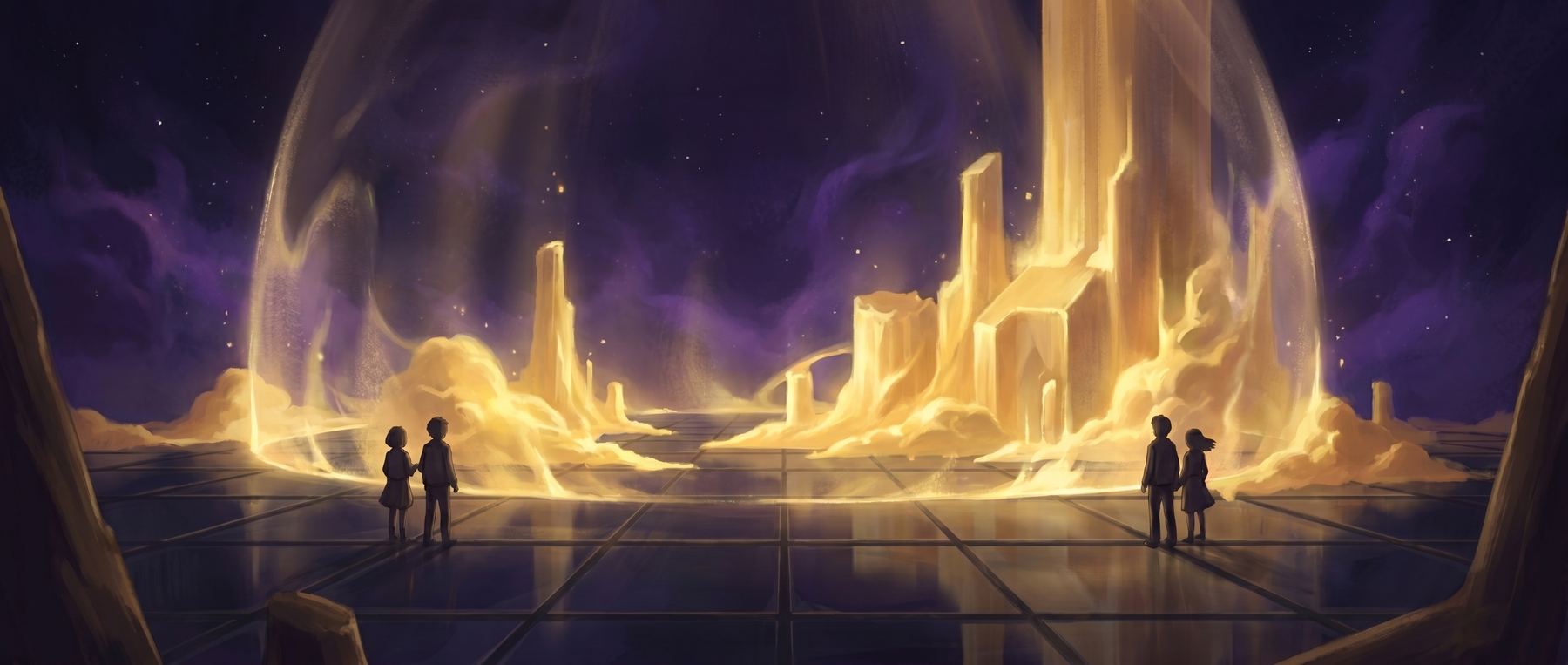
Orion's bout was four exchanges old when Kira understood she was watching two fights — the one on the sand, and the one Marcus Corvane had come to have.
She stood at the team gate with Shimmer riding her collar and Mira at her shoulder, watching the featured pairing the draw had handed the morning: Thane and Flamepeak against Corvane and his Stormlynx, a sleek Plasma-type that fought in stuttering bursts of ion-snap, brilliant and rude. Corvane was good — first-seed-half good, a legacy name off one of the fleet houses, with the particular polish of a boy who'd had the same instructors as Orion since they could both walk.
He wasn't fighting to win on the monitors. He was fighting to win somewhere older.
"Clean form, Thane," he called across the sand, conversational, while the Stormlynx circled. "Your father's form. They build you people in the same shop?" An exchange — Flamepeak's checked line forcing the lynx wide — and Corvane gave ground gracefully and kept talking. "I hear the house puts the trophies in the entry hall now. All that silverware. You'll be the fourth shelf."
Orion said nothing. That was the first wrong sign, because Orion pre-fought everything aloud — if she opens left, she won't, if she feints — and silence on him read like fever. The second wrong sign was the form itself: with every barb it got cleaner. Textbook entries, examination angles, footwork off the syllabus plates, beautiful and dead — a boy being a portrait of a house instead of a fighter in a bout. The angrier he got, the more perfectly he became what the name required, and Kira, reading him from the gate the way she read everything, thought: there's the whole family, right there in his feet. Nobody taught him fury is allowed to improvise.
"He knows Corvane's game," Mira said, hesitant-precise, wrist brace creaking as her hands worked. "They, um. The houses summer together. Knew. Used to."
The Stormlynx's burst caught Flamepeak at the turn — ion-snap across the wing, the field drinking most of it — and the yield monitor over Orion's gate ticked a band. Corvane smiled with genuine warmth, which was somehow the cruelest thing in the arena. "There it is," he said. "That's the Thane finish. Looks perfect. Arrives late. Your father had it too — ask anyone who flew with him before the family business ate—"
Orion stopped fighting the portrait fight.
Kira saw the moment land: not a snap, a release — his shoulders coming off the syllabus angles, his weight going somewhere no plate diagrammed. He didn't answer Corvane. He turned his head a degree toward his own partner mid-exchange — the first time in the bout he'd looked at Flamepeak instead of aiming him — and Kira read his mouth around words she'd heard him give Mira in a hungry garden: your line. Call it.
Flamepeak had been waiting eighteen years.
The line he chose was nothing the house had ever shelved: a low, ugly, gorgeous arc through his own dying ember-trail, banked heat flaring off the sand as cover, a strike assembled out of pure partnered improvisation. The Stormlynx, drilled to counter Thane form, met a fighter with no form at all and lost the exchange whole. The monitor over Corvane's gate slid past its line; the horn sounded; the field firmed; done.
The crowd came up chanting the name — Thane, Thane — and Kira watched Orion stand in the middle of his win with his jaw set wrong, because the name was exactly the thing that hadn't won. Flamepeak rode his shoulder out of the arena banked down to a satisfied ember, and at the gate Orion paused beside her, eyes forward.
"Don't," he said.
"I was going to say his line was better than anything in the syllabus."
A muscle in his face fought itself. "It was," he said, and went up the tunnel, and that was the whole conversation, and somehow it had been about his entire childhood.
The condition draw for her own bout came up while the floor crews reset: blackout.
The arena dark wasn't night-dark. It was engineered — the bowl's lights dropping in stages while damp-screens swallowed the stands' glow, until the sand floated in a dark as total as a depot corridor, ringed by six thousand people she could hear breathing. Her opponent was Auriga's second pair, a tall placid cadet named Imra with a Stratosail — a Gale-type, a manta of membrane and pressure-sense that fought blind better than most things fought sighted. The draw was either luck or curation: the seeing pair, struck blind; the lantern, lit in a room where lighting it lost.
That was the bout's whole cruel geometry. Shimmer's light was position, telegraph, target. Every render would paint them for the manta's pressure-sense. Forty seconds in — after the Stratosail's first dive nearly ended things, wing-pressure shoving Kira flat while her partner's reflexive flare gave them away twice over — Kira knelt in the dark with her palm against Shimmer's light and offered the plan she hated.
"Go dark," she said. "All the way. Metronome, flat, the cage trick — but ours this time, on purpose, on my count. I'll be your eyes. You be nothing at all, until you're everything."
Terror crossed the channel with its boots on — the old shame-color, the dimness was how I hid, the dimness is her — and then, behind it, arriving like a decision, the other thing: two ripples, root to tip. Yes. The skill learned under a cage's eyes, picked up deliberately, turned in the hand, aimed.
Shimmer went out like a snuffed lamp, and the dark swallowed the sand whole.
After that it was the purest reading Kira had ever done. The Stratosail hunted by pressure and patience; she tracked it by everything else — the wake it dragged across her skin, the crowd's breath shifting as it banked overhead, the arena's air-handling stuttering where membrane cut the flow. She walked the sand slow, hands open, body loud on purpose, the only legible thing in the room: bait with a pulse. Mira's count ran in her ear. The manta circled twice, committed on the third —
— and she sent one image down the bond, the dive-line and the single mark on it, and the nothing beside her became everything: Shimmer igniting at point-blank beneath the committed dive, full prismatic register from total dark, a star turning on inside the manta's pressure-map where no star had been filed. The Stratosail's world inverted. It stalled mid-dive, sensorium white; the field caught its tumble like a parent's hand; the monitor over Imra's gate slid past the line, and the horn called it.
The lights came up in stages on six thousand people getting loudly to their feet, and Kira stood blinking in the noise with her partner blazing on her shoulder — deliberate dark, chosen, and the brightest thing in the room at the end of it — and let herself, for one entire breath, feel nothing but the win.
The breath was all the room gave her.
The first wrongness was under her boots — a tremor in the sand with current in it, a sequence, deck plates counting in a rhythm she'd felt once before in a depot gallery. Then the arena systems hiccuped all at once: the house lights surged white, the damp-screens slammed open, the suppression field's everywhere-hum stuttered — a missed heartbeat in a sound she'd stopped hearing weeks ago, and her whole body heard the silence — and high on the third tier, above the packed family galleries, a condition pylon tore loose.
It was one of the blackout rig's mass-anchors, a thing the size of a shuttle engine, and it came off its track with a shriek and swung out over the stands on its service tether, shedding debris — and shedding charge, the blackout capacitors venting in a live arc that crawled down the tether toward six rows of people who had nowhere to go that mattered.
The yield horns were sounding. Crews were running. None of them were going to be fast enough, and the field — the field that caught everything, the room's whole promise — flickered in and out around the pylon like a lamp in weather, sections live, sections dead, catching nothing reliably at all.
Kira was already moving, read already built — tether harmonics, swing period, the arc's crawl-rate, a path up the tier scaffold that got her exactly close enough to die with everyone else. No reach. No tool. Beside her on the sand, Shimmer was four bouts and one deliberate darkness past spent; the small body's exhaustion came through the channel like a hand cupped around a guttering candle.
And then the channel filled with something that was not hers and not Shimmer's.
Afterward she would need three tries to describe it in the notebook: a box, but sideways — a thing she read over her partner's shoulder, addressed past her, the way you see a letter across a table and know from the first line it isn't yours.
The pattern has outgrown its fold.
Two rooms stand open:
TIDECASTER — the deep branch. Vast, patient,
a harbor. Strength that waits and holds.
SPARKDANCER — the bright branch. Quick,
luminous, a lantern that travels. Strength
that arrives.
Either room is paid for in the old rooms.
Expansion overwrites. The earliest textures
are the space it takes.
The choice seals on her acceptance alone.
The arena was screaming. The arc crawled. And inside the bond the whole world had gone still as a held note, because her partner was standing in front of two open doors with a falling sky for a deadline, and the System — nine thousand years old, courteous as ever, merciless as ever — was waiting.
"Shimmer—" Kira's voice cracked across the channel and out loud at once, and everything she knew poured through her in half a second: the open pattern, unfolded, unguarded, blazing on every sense for kilometers — they hunt the flares — and the field is failing, and if anything touches you mid-change— and under all of it, oldest of all: you don't have to prove anything, not to me, not ever, you were never the thing that ran—
What she said, out of all of it, was: "Not for me. If you open those doors, you open them for you."
She had no veto. She had never had a veto; the architecture of the choice did not contain her; that was the entire shape of what her partner was — a person, standing in her own doorway. Kira felt the small bright attention take in her counsel, weigh it, keep it — and choose.
The bright branch. The lantern that travels. Quick, and luminous, and arriving — chosen not against the fear but straight through its center, by a droplet who had spent her whole small life being told by cages what size to be.
Shimmer unfolded.
There was no flash. That was the first terrible mercy — it was slower than catastrophe, a geometry opening like a hand opening, the teardrop's folded pattern unfurling room after room after room, and every Resonance-sensitive thing in the arena turned toward her at once. Six thousand people felt something and stood transfixed; a hundred Asterials felt everything and went silent; and to Kira, channel wide open, it was like watching a house she had lived in discover it had always been a city. And it was naked — that was the second thing, the thing that made her stand guard over the unfolding body with her fists up against an arena, useless and absolute: for nine endless seconds her partner was an open pattern under a failing field, unguarded, legible, a lit window in a dark country, and anything that struck her now would catch her half-unfolded and keep her that way forever.
Nothing struck. The nine seconds ended. And what rose off the sand was a ribbon of living light a full meter and a half long — serpentine, quicksilver, prisms chasing down her length like weather down a coastline, the same blue-white heart wearing a body built of arrival.
The pylon's tether failed.
Shimmer crossed the arena like her own name. Faster than the bout, faster than anything the sand had seen all season — up through the failing field's dead zone, meeting the falling mass and the crawling arc at the intersection Kira's read had marked, and she did not catch it, nothing her size caught that, she painted it: a woven lattice of hard light thrown across six rows like a net, every line load-true to Kira's geometry, the pylon shedding its speed into the web in a long shrieking skid of brilliance while the vented arc grounded out along a painted channel into the tier's bones. Debris rained through gaps no person was standing in, because the gaps had been chosen.
The pylon came to rest against the lattice, smoking, two meters above the gallery rail and a grandmother who had not had time to stand up.
Silence. Then the sound a crowd makes when it has watched the sky fall and not land — six thousand people exhaling each other's names — and under it, in the channel, one small exhausted light saying nothing at all, and being, Kira understood with her heart going sideways, entirely changed, and entirely still there.
The boxes had the manners to wait, and to come one at a time.
The first found her on the sand, in the chaos of crews and medics, with Shimmer pooled — pooled still worked; the new body still pooled, thank every star — across both her arms, heavier than yesterday.
Tidespark → SPARKDANCER (Stage 2)
She was offered a harbor.
She chose to be the light that arrives.
The choice was made with strangers falling
and no one watching her courage but you.
Something was overwritten.
You will both find its edges.
You will both find its edges. Kira read the line four times, cold gathering under the relief, and filed it where she filed every bill that hadn't arrived yet.
The second box waited for the tunnel, away from the noise.
The horn had sounded. The win was already
yours, and you both turned your backs on it.
An arena is an array; every seat in it is a
witness. When the array broke, you kept
the witnesses.
The third thing was not a box, and it stopped the world.
It came in the medical bay, in the quiet after Yeun's instruments had pronounced the new pattern stable and the old injuries merely old. Kira sat on the cot edge with the changed body coiled loose around her forearm — getting acquainted, both of them, with the new weight, the new length, the harmonics arriving down the channel with registers she didn't have names for yet — and her fear finally caught up with her the way fear did, after, in the quiet. Changed. Entirely changed. The cradle-vision, the meter-wide world, the small frightened light she'd sat down on a scorched deck for — how much of that person had paid for those new rooms? She reached down the bond, careful as a hand into dark water, not even knowing what she was asking —
— and the answer came back in a word.
Not an image. Not a feeling, not a question made of light. A word, single, effortful, carved out of whatever words cost a being made of pattern and paid for in full — arriving down the channel in something that was unmistakably, impossibly, a voice. Small. New. Hers.
Found.
Kira didn't move for a long time. The medical bay went on humming. Somewhere two rooms away, Yeun was saying ordinary sentences to someone. The whole arena, the whole institution, the whole watching sector went on doing what it did — and she sat with her partner coiled on her arm and the first word her partner had ever spoken ringing in the middle of her like a struck bell, because of all the words in every language Shimmer had been hoarding, she had spent that one. The Chapter 3 word. The both-directions word. Still here. Still us. Still found.
"Yeah," Kira managed, eventually, in a voice that had been recently dismantled. "Same answer from this side."
What you say can reach her now.
What she says will cost her. Spend gently.
Her state, as you read her:
new · tired · unafraid · yours
The last box came on the walk back to 217-B, in the old courteous spacing, corridors empty, station night-cycle dimming the lights ahead of her step by step. She walked it slowly, carrying the new word the way you carry a full cup.
You stood inside your own terror and spoke,
and left her door open, and let her walk
through it without your hand on her back.
HAR 10 → 11
The number became a body the way the numbers did: a roominess, somewhere behind her sternum where the channel lived — like a corridor she'd always sidled through learning it had been built wide enough to walk abreast. She flexed her healing knuckles and filed it.
In quarters, Shimmer arranged her new length across the basin in experimental configurations, dissatisfied with each, a person learning to sleep in a bigger bed — and finally settled in a loose spiral with her head-end resting on the rim nearest Kira, light breathing slow.
Kira got the notebook out and sat with the pencil still for a while.
21:58 — Stage 2. Her choice, witnessed; my counsel kept but not obeyed, which is the whole point of counsel. New word in the universe: one. Cost: "something was overwritten — you will both find its edges." We haven't found them yet.
She looked at the entry, then added the line the day had really been about, the one with the chill in it.
Note for the file: for nine seconds she was an open pattern under a failing field, legible for kilometers, and the field failed at exactly that moment, and "condition-system fault, under review" is what they stamp on things they've stopped looking at. Everyone within three klicks felt her unfold. Question: who was listening on purpose?
✦ Chapter woven into the thread ✦
Next — Chapter 14: Between Rounds