Part One · The Orphan's Song
Chapter 14Between Rounds
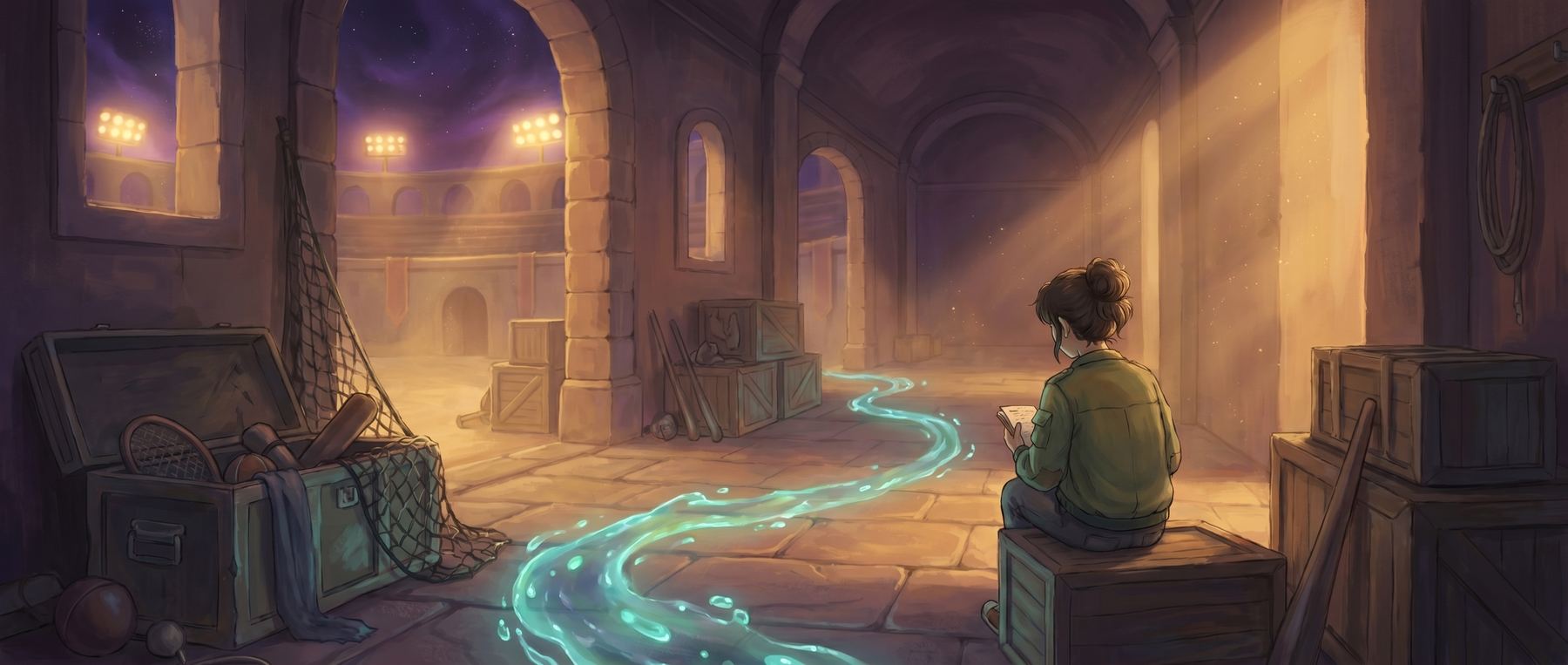
Kira woke at 0507 to the sound of someone searching a house in the dark, except the house was her partner and the dark was inside her.
It came down the channel as motion without direction — Shimmer moving through her own pattern the way you move through rooms at night, opening doors, finding the light switches, finding the lights. The new body lapped the basin in slow circuits, prisms running long and uneasy down her length, and every few seconds the searching came back to one place and stopped, and pressed, and found the same thing again.
Kira sat up. "Hey. What is it?"
The answer was an image, and the image was an outline: a shape drawn in absence. A cradle — the meter-wide world, the warm dark, the choir of older lights singing a new pattern stable — every texture of the memory intact, the warmth, the smallness, the singing-toward-her — except the song. Where the song had been, the image simply stopped. Not silence; silence is a thing you can hear. A hole with the exact shape of a melody, edges clean as drafting film, contents gone.
The cradle-song. The first sound her partner had ever known, the choir singing her stable in the warm dark before fear, before cages, before numbers — that was what the new rooms had been built on. Shimmer reached for it the way you reach for a handrail your hand has known for years, and her hand went through the wall, and she reached again, and again, because some kinds of gone take the body a long time to believe.
You will both find its edges. They'd found them. The edges were the shape of a lullaby.
"Oh," Kira said, very quietly. "Oh, no. Come here."
Shimmer poured out of the basin and up her arm — heavier now, longer now, and for once both of them grateful for the new length, because there was more of her to hold. Kira sat on the floor with her back against the bunk and her partner coiled across her lap and shoulders, and did not say any of the useless human things. She didn't say maybe it'll come back; it wouldn't, the box had said overwritten and the box did not lie. She didn't say you'll learn a new song; Shimmer's grammar held one law older than the bond — you do not sing another's song, and the dead's songs are retired forever, and now her own first song had joined that silence while she was still alive to miss it.
What she said, in the end, in the plain field-note voice she kept for things too large to feel all at once, was: "Tell me about it. Not the song — I know you can't. The around-it. What it was for."
And Shimmer, slowly, in images, did. The warmth that had a rhythm. The bigness of the older lights and the way the song made bigness safe instead of terrifying. The feeling — she built it across the channel with enormous care, like a person carrying water in their hands — of being sung to, before she had done anything, before she was brave or useful or bonded or anything at all. Of mattering on arrival.
"Yeah," Kira said. Her ceiling, three rooms and twelve years away, had glow-paint stars on it for the same reason. "That one I know. We keep that part. The hole gets to be a hole — we don't pave it, we don't fill it with something cheaper. We just learn where the edges are, so we can live next to it without falling in." Her voice did something and she let it. "I've had practice. I'll show you."
Shimmer's light ran one long ripple, root to tip, and then — not the second ripple, not yes, something slower and more spent that the channel translated all the same: stay. They stayed. The station's morning came up around them in increments of ventilation and far-off boots, and neither of them moved until it had fully arrived, and no box interrupted, because some hours even the network knows better than to annotate.
Lyra Vex was waiting in the concourse outside the arena's service level, and she had the look of a woman spending the last of something.
"Row K," she said, in lieu of any greeting. "Third tier, under the condition rigging. There was a crew up there during the quarterfinals — six, coveralls, equipment cases. No crew chief I've ever drunk with knows them, and no manifest I can reach has them on it." Her flat eyes held Kira's. "Now we're even."
"Even for what? You warned me before yesterday's—"
But she was already walking, boots even, spine straight, and the only other thing she said arrived over her shoulder, unbought and unexplained: "Pull your partner out of that final, Vance. New patterns tear easy."
Row K, third tier, was a service catwalk smelling of ozone and cold grease, and it took Mira eleven minutes to find the first device because it had been installed by people who were good at their work. It sat clamped to the blackout rig's signal trunk like a gray fist — palm-sized, fanless, no maker's mark anywhere on it, no hollow triangle either, which Kira found she distrusted more.
"It's not a bomb," Mira said, half under the trunk housing, brace creaking. "It's not a — hm. It doesn't do anything to the rig. It listens to the rig and then it, um." Her hands stopped. "Oh. Oh, that's ugly."
"Footnote to headline, Chen," Orion said.
"It's a jammer, but not for comms." Mira slid out. Her face had gone the color of the catwalk. "It injects noise into a resonance channel. Phase-built noise — tailored static. You'd never aim it at a shield or a strike; the field eats those anyway. The only thing in an arena this would hurt is—" and she made herself say it in the open air, "—a bond. It's built to get between a pair. Fray the sync. Make two readers disagree about edges until the channel tears itself."
The catwalk was quiet except for the rig ticking. Kira stood very still, because three weeks of enemies had just changed shape in front of her. Cages, Sigils, governors — everything in the hollow-triangle catalog attacked the Asterial: lock the pattern, drain the pattern, number the pattern. This gray fist attacked the thing between. Someone had studied what made the pair a pair, and built a tool for exactly that seam, and bolted six of them — they found the other five inside the hour — around a sand where she and Shimmer were scheduled to stand tomorrow.
"Yesterday's tremor," Orion said grimly, photographing serials that matched no registry he had access to. "The pylon, the field stutter. That wasn't the attack."
"No." Kira's voice came out in the field-note register, which was the only one that would hold. "That was the sound check."
They went to Stellan because that was the order of operations — me first, then the institutions — and the order of operations was how they learned she was gone.
Her office door stood sealed and dark. Not locked-for-the-night dark; decommissioned dark, the door seal showing the gray standby band of a room whose environmental account had been closed out. Orion badged the panel; it referred him to Administration. Mira badged it; it referred her to Administration with a half-second lag that made her flinch. Through the door glass, in the spill of corridor light, the office was wrong in a way Kira's pattern-sense itemized against her will: the star charts gone from the walls. The shelves bare. The desk clear except for a single object, centered with terrible deliberateness, where a note would go if a person left notes.
Her telescope eyepiece. The antique's, the observatory's, the one Kira's own eye had warmed eight nights ago.
"Administration says Professor Stellan took an emergency research leave at 0410," Mira reported from her pad, qualifiers stripped, voice thin. "Effective immediately, duration unlisted, destination unlisted, authorization—" she stopped.
"Authorization what?"
"Authorization: Office of the Director."
Kira stood looking at the eyepiece through the glass — a message with no words on it, from a woman who answered questions with questions, abandoned in a room the institution had already finished erasing — and felt the week's geometry close another door in the sequence. Win or lose, you will come find me before you speak to anyone with a title. Eight nights ago. She'd known. The old woman had stood in the observatory handing out last lessons because she'd known she was spending their last untitled hour, and she had still made it a quiz.
"She didn't leave that for Administration," Orion said quietly, looking at the eyepiece.
"No." Kira made herself turn from the glass. "She left it for whoever came looking in the right order."
The station address system chose that moment, with institutional timing, to clear its throat.
Following a systems irregularity (ref:
condition-fault 3-117, under review), the
tournament grounds are LOCKED DOWN.
All cadets confined to Trials sectors.
Departures suspended. Withdrawals suspended.
Per Directorate ruling, the Trials will
conclude on schedule.
Sabotage hardware in the rigging, the saboteurs' crew unfound, the one adult Kira trusted erased from her own office — and the institution's answer was to seal every door, suspend every exit, and run the finals anyway, on time, under lights. She read the notice twice and heard Stellan's voice reading it with her: an arena is a fitting. They wish to learn what you're an instrument for.
She tried to withdraw anyway. It took forty minutes to get the hearing — a gray annex room, Dray at the table with his stylus and his patience, Hale arriving late and standing, arms folded, by the wall.
"The pair is four days out of an evolution," Kira said, level, documented, the splinted-and-bruised file of Team Sigma-7 open on the table between them. "Her pattern is new. There is anti-bond hardware bolted to your arena that your own crews didn't install and can't trace. I am formally requesting withdrawal from the final round on safety grounds."
"And the Directorate has formally suspended withdrawals," Dray said, with the mild regret of a man reading weather. "Though I'd remind the cadet: participation satisfies her assessment compliance. Non-participation—" he let the stylus rest "—would, regrettably, reopen the question of an unsatisfied assessment. The remand motion was denied, not dismissed. Calendars can be revisited."
There it was. The trap Hale had built in a hearing room three weeks ago, sprung at last, every tooth where Kira had mapped them. She looked past Dray to the Director, who had not yet said one word, and asked the question straight. "The devices in row K. Your investigators have them now. Do you know who placed them?"
"No," Hale said. True sentences; always true sentences. "The investigation is active. The arena will be swept again tonight, the rigging crews re-credentialed, the field generators inspected to a standard I will personally sign." A pause, and then the Director did the thing she did, the thing that made her worse than a liar: she said the rest of the truth. "And the Trials will conclude on schedule, Cadet Vance, because eleven thousand people now wish to see you fight, and among them are the people my investigators most need to see in one room, behaving as though their work last night succeeded. You are, I'm told, familiar with the principle. Arrays point both directions."
Kira stood in the gray annex with her own sentence handed back to her as policy, and understood that she had just been entered, again, as evidence — bait this time, sworn in without consent, in a sting the institution would run with her partner's new-torn pattern as the lure.
"Noted for the record," she said, "that the bait objected."
"So noted," said Hale, and almost — Kira's pattern-sense flagged it and filed it — almost looked sorry.
Mira found the last thing at 2240, and the last thing was the one that didn't fit on any chart.
They'd commandeered the team ready-room: Orion deep in registry shadows, hunting the ghost crew's credentials; Verdant and Flamepeak and the long new ribbon of Shimmer in a quiet heap in the corner, patterns politely desynced from their fretting humans; Mira at the table with one of the confiscated jammers — requisitioned for independent verification, said the form she'd somehow gotten signed — opened up under a work lamp.
"The noise isn't generic." Her voice had gone hesitant in the way that meant the content was about to be precise and terrible. "Tailored static, I said. I assumed tailored to — bonds, the category, some lab model of a channel. It isn't. There's a reference signature etched into the filter stage. The noise is built as an inverse — a key cut for one lock. One specific channel." She looked up, and didn't make Kira ask. "It's yours. Yours and Shimmer's. The filter signature is your bond's harmonic profile — and Kira, the resolution is perfect. This wasn't reconstructed from somebody's scanner in a crowd. This is laboratory-grade. This was cut from a recording."
The ready-room was very quiet.
"There's exactly one recording like that in the universe," Kira said slowly. The cold arrived ahead of the words, the way it always did. "Continuous channel telemetry. Compliance revision two." She heard her own voice flatten into the file. "They cut it from telemetry file 7-7. Image-event-1. The division's instrument — the leash. Somebody took the leash and forged a knife from it."
"Which means somebody with access," Orion said. "Division access, or—" he didn't finish, because the unfinished half stood in the room with them anyway: or the kind of access that authorizes emergency research leaves at 0410 and closes offices by morning.
Mira was looking down at the jammer's open guts, and her answer, when it came, came half a beat early and sanded smooth: "Access logs for division telemetry are sealed even from division staff, there's no way to know, we shouldn't guess." All one breath. Numbers-girl Mira, who corrected estimates reflexively, even mid-crisis, even her own — declining to estimate.
Kira looked at her friend across the work lamp for a long moment. The half-beat hum of the room's instruments filled the gap where her sight was assembling something it did not want to assemble — answers arriving early are answers prepared in advance — and she took out the notebook, and wrote, and this time did not cross it out.
22:51 — M. answered before the question finished. Second logged instance. The first was about my parents' heading. This one was about sealed access logs. Note: both are doors with the same office behind them.
She closed the notebook on it, because in seven hours she had to stand on sand she now knew was a stage, inside a field she now knew could fail, against the first seed, in front of the buyers Lyra had promised, with a knife cut from her own bond's recording somewhere in the dark — and whatever was wrong with Mira's half-beats, it would have to stand in line.
Seven hours.
She went to tell Shimmer the count still held.
✦ Chapter woven into the thread ✦
Next — Chapter 15: The Finals