Part One · The Orphan's Song
Chapter 17Stellan's Truth
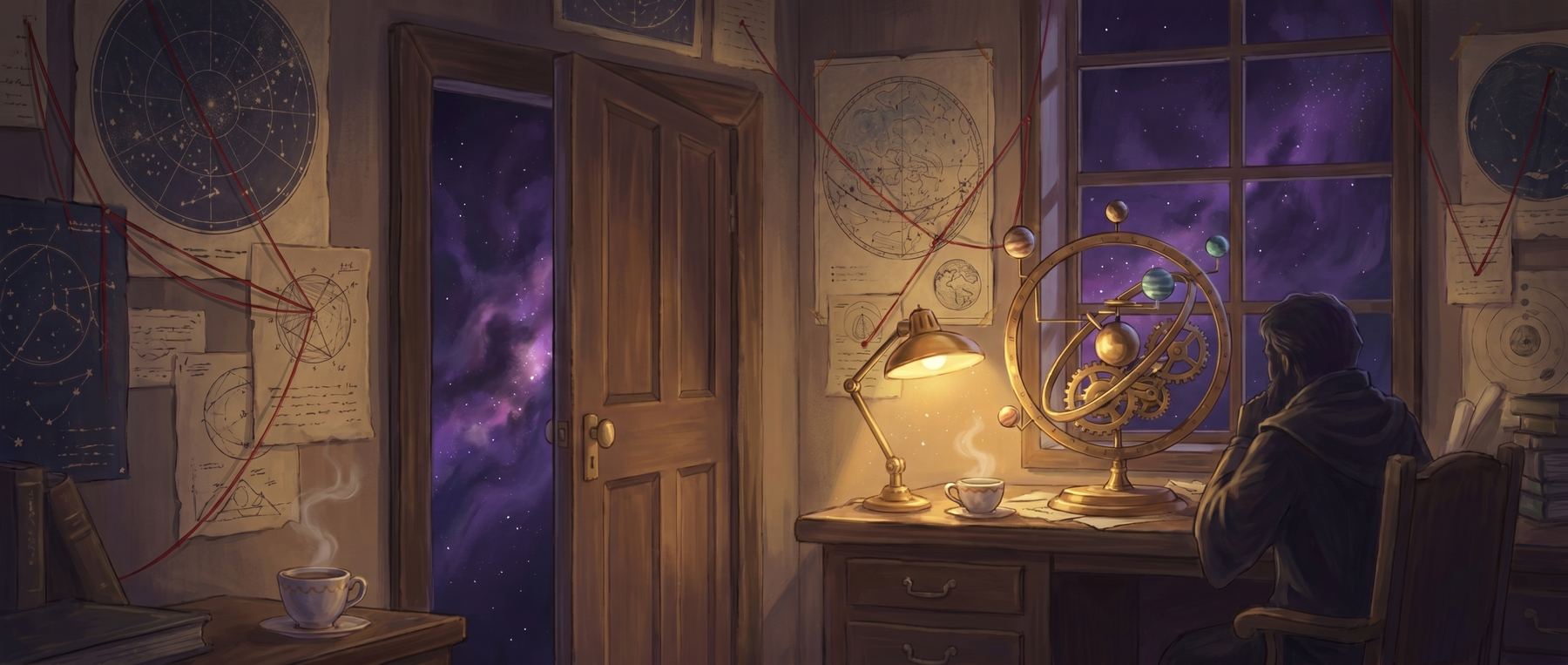
At 0311 Kira came down the dead service tunnel into the bowl with her lamp off, one hand on the scorched rail, navigating the dark by a map she'd made while eleven thousand people screamed.
Shimmer rode against her collarbone in the carry-sling Yeun had grudgingly certified — transport only, no work — because the alternative had been leaving her in the basin, and her partner had answered that proposal by climbing out of the water one slow body-length at a time and waiting at the door. No images, no words; the winterburn rationed everything. Just the fact of her, dim and certain, a cool weight over Kira's heart that said where you go in the oldest grammar they had.
The bowl at night was a held breath. Emergency lamps on the far rim where a cleanup crew worked the blown gates — the cats, lamplight swinging, voices small under the dome. Between them and Kira: a thousand square meters of ruined sand, light-burns fanned across it like pressed flowers, the dead pylon track overhead, and the patchwork of field sections — some live on maintenance trickle, some dead — that her pattern-sense rendered as a chessboard only she could read.
Stellan was standing in the middle of it, on the exact spot where the drowned one had settled, looking up at where the Lantern had been.
She wore a maintenance coverall, which on her looked like a costume worn by someone grading the costume, and she did not turn as Kira crossed the sand — stepping the seams between live sections without thinking about it, which was its own kind of credential.
"Cadet," Stellan said. "You're four minutes early."
"You're earlier."
"I'm old. Arriving early is how we audition for punctuality." She turned then, and in the work-lamp spill her face was the same as ever — the rubric eyes, the dry seam at the mouth — and also not: tireder, simpler, like a room with the furniture taken out. "Walk with me. Standing still is how you get noticed, and there are cats."
They walked. The crew's lamps swung along the far gates; whenever a beam traversed the sand, Stellan altered course without urgency, keeping wreckage between them and the light, and Kira understood that the path they were tracing had been surveyed in advance — a walking route through a ruined room, built by a woman who had been not-being-noticed since before the Academy had a name for it.
"You found the eyepiece," Stellan said. "And you read the cover note, and you came at the right hour, alone except for the half of you that doesn't count as company. Good. Now tell me what you brought."
"Questions."
"Inflation. Last month you'd have said one." A lamp swept; they paused in the lee of a wrecked pylon base; it passed. "Ask the accounts first. Always the accounts first. What does your notebook say happened in that depot vault?"
Kira had the page by heart and recited it like coordinates. "A personnel ledger, water-stained, roughly sixty years old. Line item: Survey Specialist C. Vance — sole survivor, A.V. Calíndra. Transferred to program, special dispensation." She watched the old woman's profile. "I photographed it twice and told no one with a title. As instructed."
"And the symbol on the oldest crates."
"A triangle with a six-pointed star inside. The hollow mark everywhere else is the same stamp, revised. They subtracted the center and kept the walls."
"And four nights ago, while a room of eleven thousand people was being told what your name sold, your Gauntlet received three words on a narrowcast." It wasn't a question. Stellan resumed walking, slower. "Special dispensation, Cadet Vance. The ledger's phrase. Sixty years old, water-stained, in a vault behind a struck-off registry — and somebody spent it on you like pocket change, point-to-point, to be sure you knew you were known." A pause, the length of a held breath. "That narrowcast is why we're having this conversation, Cadet. Up until it arrived, your ignorance was armor. I have spent sixteen years maintaining that armor. They have now written on it. Armor with writing on it is just a label."
The cold went through Kira in a way that had nothing to do with the bowl's dead air. Sixteen years maintaining. She put it above the line and kept her voice flat. "Then tell me what the Calíndra was."
"A deep-survey vessel. Sixty-eight years ago she took the best expedition the Academy ever fielded out past the last Beacon, following the same arithmetic you've been following — corrections that didn't sum, records too smooth, a network limping where every gauge read well." Stellan stepped across a live field seam, precise as a cat herself. "She found what was making the stars flicker. It is not tonight's lesson. What matters is the manifest: forty-one souls and nineteen bonded pairs went out. One man came back. The Academy met him at the dock with a medal in one hand and a sealed-records order in the other, and then it did the most dangerous thing an institution can do with a grieving genius."
"It gave him a budget."
"It gave him a program." The dry seam deepened, without any humor in it. "Quiet, chartered, internal. Resonance hazards, the charter said. Study what happened. Make sure it never happens again. And the program's star was the survivor himself — brilliant, gentle, certain of exactly one thing in all the universe." A lamp swung; they stopped; it passed. "That connection had killed his crew."
"The bonds," Kira said slowly, the wreck's cage-grammar assembling itself behind her eyes. "Nineteen pairs. Whatever it was — it took the bonded first."
"It took the bonded hardest. There is a difference, and the difference is where his arithmetic went wrong, and no one ever managed to show him the remainder. Not his colleagues. Not his daughter." The next sentence arrived measured, a true sentence chosen off a shelf of them. "Not me."
Kira stopped walking.
Stellan did not. Three more steps, then she paused by the long scar the pylon had cut in the sand, and looked back, and the work-lamps made her braid a line of silver wire. "The program ran twenty-seven years. By the end there were three of us in its inner room. A field Arbiter named Vira, who came to us the year the Wound took her partner out of the sky in front of her — grief recruits, Cadet; it is the only recruiter that organization has ever needed. The survivor, who ran it. And a younger woman who believed that keeping honest records was a form of love, and filed every dissent in triplicate, and told herself that staying inside was how you steered a thing." She held Kira's eyes. "Then one quarter-day I audited a fabrication requisition that had been routed around my desk, and found the schematics for a device whose purpose was to force a living pattern closed and keep it closed. They had begun building cages for the thing they were afraid of, and the thing they were afraid of was love, and I understood that I had not been steering. I had been lending the brakes my name."
"The Schism," Kira said. "The Academy buried the program."
"The Academy buried the paperwork. The program walked out the door with its budget's ghost and its true believers and its symbol — and revised the symbol, since you've asked the right question about it. The six-pointed star in the center was the program's first honesty: the Asterial at the heart of the work, the thing being studied, the thing being protected. When they left, they kept the walls and subtracted the center." She let that stand a moment in the ruined room where five hollowed creatures had been driven across the sand on goads. "You have seen with your own eyes what a wall with no center protects."
The lamps were working closer along the gates. Stellan resumed the route, and Kira walked beside her, and the question she had carried down the tunnel — the one below the line, the one she had been circling since a vault on a dead depot — finally refused to wait any longer.
"C. Vance," she said. "Survey Specialist C. Vance, sole survivor, special dispensation." Her voice did the thing she hated, a hairline crack across the field-note glaze. "I deflected the surname in front of my whole team. I've deflected it for nine days. I'm done. Who is he to me?"
Stellan stopped walking.
She turned, all the way around, unhurried, and folded her hands, and for the first time in sixteen years she did not answer a question with a question. The quiz fell away from her face and what was under it was very old and very tired and very kind.
"Cassian Vance is your grandfather," she said. "Elena's father. He is alive. He leads what the program became. And he is the kindest man I have ever known."
Kira sat down.
Not a decision — her knees made it for her, and the pylon scar's edge took her weight, and she sat on the wreckage in the middle of the ruined bowl with her partner a dim cool weight against her chest and her own notebook rule ringing in her skull like a struck pipe. The day she does, be somewhere you can sit down. She had packed the folding stool as a joke against the universe. The universe had called it.
Against her collarbone, Shimmer's light made one faint slow ripple, root to tip — effortful, rationed, real. Not a word; words cost too much now. A pressure, shaped like a hand under an elbow. Here. Still here.
"The narrowcast," Kira said, when she had a voice. "That was—"
"His house style? No. He would not have sent it; he would consider it cruel, and he is never knowingly cruel, which I require you to understand before you meet him, because it is the most dangerous thing about him." Stellan lowered herself onto the scar's edge an arm's length away, joints negotiating, an old woman sitting down in the middle of her own life's wreckage. "You are imagining a fanatic, because the goads and the cages belong to a fanatic. Imagine instead the gentlest man in any room he enters. A man who will pour your tea before his own and ask after your partner's seam with genuine concern and grieve you in advance, with complete sincerity, while his organization decides what your bond costs the sector. His grief is sixty-eight years old and it has never once been wrong about the danger, and that is what makes everything downstream of it so hard to fight. Every villain is right about one thing, Cadet. He is right that the dark is real. He has simply spent his whole life building the wrong shelter."
"And my parents—" Kira's hands had found the notebook without her noticing; she made them be still. "The expedition. They weren't chasing the flicker."
"They were chasing the flicker the way you chase a thing you already understand. Elena grew up inside her father's arithmetic — she could recite the program's catechism before she could fly. Then she went out and did the fieldwork, with Marcus, the two best survey minds of their generation, and the fieldwork told her the remainder her father refused to carry." Stellan watched the work-lamps. "They discovered what the program had graduated into. The scale of it. And they did what good surveyors do: they tried to report it. The report went up the line, and the line, they learned, was a door with the wrong office behind it. So they stopped reporting. They filed a heading they wanted read, flew a heading they didn't, and went to answer the dark themselves, before the man they loved could finish locking it out." The next words came slow, weighed twice. "They did not vanish, Cadet. They steered. Whatever was at the end of that heading, they chose it over telling an institution one more true thing. I have spent twelve years failing to decide whether that was their wisdom or their father's stubbornness wearing their faces. Probably it was both. Inheritance usually is."
"Are they alive?"
"What do your accounts say?"
"My accounts say their true heading exists." Kira heard her own voice go quiet and even and dangerous. "My accounts say Hale pronounced them dead in a register that means somewhere there's a file. My accounts say everyone who knows anything has decided what I can survive knowing, and I am sitting in a wrecked arena at three in the morning interviewing the only adult I trust by lamplight avoidance because the institution we both work for erased her room." She closed the notebook. "You watched me for sixteen years. The Fringe posting was yours. The observatory lock was yours before it was mine. Why?"
"Because I was the third of three, and the other two went into the dark — one to build walls, two to tear them down — and someone had to stay where the child was." No question deflected it; her budget of directness, it appeared, had been saved up for one night and was being spent entire. "I assigned myself. No one asked. Your parents didn't know — couldn't, a watcher you know about is a watcher the wrong people can find. I requested your postings, mis-shelved your psych evaluations, taught survey history to four thousand cadets so that one of them would learn how to keep accounts, and I have lied to you by omission every single day of your life, in the genuine belief that a truth you can't yet survive is just a slower weapon." She looked at Kira directly, the rubric gone. "It cost more than I will tell you. Secrecy as care is still a debt, and tonight I am paying what of it can be paid. The rest follows me out."
"Out." Kira's chest tightened around the word. "You're leaving."
"I left four days ago, on paper. Paper is the only place the institution looks." Stellan rose, brushing scorched sand from the coverall with two efficient strokes. "The stamp on my leave order says Office of the Director, and I will let you sit with the fact that I asked her for it, and that she signed it, and that neither of us explained ourselves to the other. Hale is not your friend, Cadet; she is also not your monster. The building has more than one current in it. Learn to read which one is moving a thing before you decide what the thing means."
"Where will you go?"
"Ahead of you." The old woman pulled the coverall's collar up, and somewhere under the dryness was something that moved like light behind a closed door. "You are going off the map. We both know it; don't insult my eyesight by denying it. When you go, you will need to move without the network reading you, and there is a man on the Ring who sells exactly that. A fixer. Transactional warmth, doors propped open, keeps a basin warm that nothing swims in — you'll know him by the basin. Tell him the third colleague is calling the last one in. He will pretend not to know what it means. He will know what it means." She paused, and the next sentence was a teacher's again, almost gentle. "And mind your order of operations from here forward, Cadet. It changes tonight: your own people first. The institutions never."
A work-lamp swung wide across the sand, and they both went still in the pylon's shadow until it passed, and the passing took eight seconds, and when Kira turned back to say the thing she had never once said aloud to this woman — the vulnerable thing, the thank-you shaped like sixteen years —
— the shadow beside her was empty.
Sand, scar, the dead pylon track overhead. No footsteps. No silhouette against the gate-lamps. An exit executed mid-lesson, the way she'd ended every argument Kira had ever watched her win, leaving the last word vacant on purpose because the student was supposed to write it.
Shimmer's light rippled once against her collar, slow, root to tip. A question-shape, faint through the muffled channel: gone?
"Ahead," Kira said. "She said ahead."
She sat back down on the pylon scar for one more minute, because her knees were honest even when her voice was level, and got the notebook out, and printed the entry by the far-off swing of the cleanup lamps.
03:51 — She answered directly. Grandfather. The kind-eyed man behind the triangle is my mother's father, and the kindness is load-bearing, and the armor has writing on it now. Note for the file: she saved sixteen years of directness and spent it in one night, like a woman settling accounts before a journey. People settle accounts when they don't expect to be back.
She looked at the last sentence a long moment.
It felt like cowardice. But so did the certainty.
✦ Chapter woven into the thread ✦
Next — Chapter 18: The Decision