Part One · The Orphan's Song
Chapter 18The Decision
The heading problem killed the planning session at minute forty, and Kira stood over the chart table watching it die.
She'd opened the morning by paying the team what she owed them — the whole 0317 accounting, delivered in the ready room with the door sealed and her voice flat: the Calíndra, the program, the Schism, the symbol's subtracted center. The grandfather. She'd watched the word land on each of them: Orion's jaw setting into siege configuration, Mira going very still over her pad, Flamepeak's banked scales dimming a courteous half-shade. Shimmer had pressed against her collarbone through all of it, a cool dim weight, rationing herself.
Now the sector chart was spread across the table with twelve days of work on it, and all twelve days drained into the same hole.
"The registered lane is swept space," Kira said. "Twelve years swept. The search flew my parents' filed heading because it was filed, and it was filed because they wanted it flown — that's the whole shape of it. The true heading went into exactly one kind of place: a drawer that doesn't report up the line. Greenlight kept that kind of drawer." She set her knuckles on the chart's green-flagged node. "So we go back. I get Fern alone, and I ask the warden-channel question, and we lose six days in transit we don't have—"
"You don't need to go back."
Mira's voice. Small, and wrong — wrong the way her answers had been wrong twice before, except this time it wasn't half a beat early. It was half a beat late, and sanded down to the grain, and her hands were folded on her pad like a witness at a hearing.
The room went quiet. In the corner, with the politeness of long practice, Flamepeak and Verdant drifted together and desynced their patterns from their partners — the Asterial custom for weather their humans were about to make.
"Mira," Kira said.
"I need to — there's a sequence, and if I don't do it in sequence I'll do it wrong, so." Mira unfolded her hands. Refolded them. The false starts fell away all at once, the way they did, leaving the precision bare underneath. "On the eighth night at Greenlight, in the records annex, I found the seam between the station's true logs and the Academy's smoothed copies. You know that part. I shared that part." She breathed. "I didn't share the rest. The node survey your mother filed twelve years ago has an addendum. It isn't in any registry. It lives in the warden-drawer — the gardener's drawer, the things Greenlight doesn't send up the line. I read it. I copied it. I've had it for twenty-four days." A pause; the reflex fired even now, even here. "Twenty-three. Twenty-three days."
Kira did not move. Something behind her sternum had gone very cold and very patient, and it was not fear.
"Sequence," Mira said again, to her own hands. "Item one. The addendum is an outbound course plan. Filed as a courtesy between people who trusted each other — your parents and Fern's predecessor. Coordinates running off the registered lane, deep into the Fringe. Deliberate. They didn't get lost, they steered — and I sat in this room forty seconds ago and listened to you reconstruct that from Stellan's hints, and I could have saved you the reconstruction, because I have the heading. The true one. On my pad. It has been on my pad through the depot, through the Trials, through the finals." Her voice held, barely, by visible engineering. "Item two."
"Mira—" Orion started.
"Item two." She took the pad off the table but didn't open it; she had it by heart, of course she had it by heart. "Under the course plan there's a note. Your mother's hand, on station flimsy. It says: Don't send this up the line. The last two crews who reported what we're following lost their funding first and their flight clearances second, and I've stopped believing that's coincidence. We'll come back for the original." Mira's eyes came up for the first time, and they were wet, and her voice stayed surveyor-steady underneath, which was somehow worse. "And then there's a space. About a breath wide. And then it says: If our daughter ever comes this way — and she will; she's built for it — tell her"
The sentence stopped. Kira heard it stop — heard the shape of the stopping, the pen lifted twelve years ago on a comma's worth of air and never set down again.
"Tell her," Mira repeated. "It's unfinished. The flimsy's whole; the sentence just — stops. Your mother began a message to you, Kira, addressed to you, twelve years ago, and lifted the pen, and I have been carrying it for twenty-three days, deciding when you were ready to read your own mail."
Nobody breathed.
"Item three." Quieter now. The last weight. "I always check access logs. The warden-drawer file had been opened exactly once before me. Eleven years ago. Credential: Office of the Director." She set the pad down on the chart, in the middle of the swept lane, and slid it toward Kira like a yielded gauntlet. "The same credential on the custody transfer. The same credential on Stellan's leave. Both doors, the same office, and I knew it nineteen days before you wrote it in your notebook, because I watched you write it — I watched you log my own wrong answers and cross one out, and I sat there and let you cross it out. That's everything. That's the whole drawer. The sequence is over."
Kira looked at the pad.
The cold patient thing behind her sternum stood all the way up.
"Twenty-three days." Her voice came out in the field-note register, which was the only one that would hold, and it held for exactly two sentences. "The night you found it, I was forty meters away. Asleep over her basin."
"Yes."
"I asked you — on the transit home, I asked you straight out where they'd gone, and you said—" the glaze cracked; the heat came through it; her voice climbed without permission— "you said the registered lane, presumably. Presumably. You had the true heading in your pocket and you handed me the lie with a qualifier on it, like a — like a citation — and I logged that something was wrong with the answer and then I crossed it out, because it was you, because of everyone on this station I don't audit you—"
"I know—"
"My mother wrote tell her." Kira's hands had gone to fists, and the wraps creaked, and somewhere far off her bruised knuckles reported in and were ignored. "Three people in twelve years have had a message from my mother addressed to me, Mira. The office that buried it. The friend who held it. You watched me photograph a sixty-year-old ledger line with my dead family's name in it and shake — you stood next to me in that vault — you watched eleven thousand people get told what my name sold, and the whole time, the entire time, you had her handwriting—" The sentence hit something it couldn't cross and broke. She made herself stand still. The stillness was worse. "Why."
"Because you would have gone." Mira didn't flinch from it; she'd had twenty-three days to find the sentence, and it arrived with all her precision and none of her qualifiers. "Alone, on probation, surveilled, flagged — you'd have been off this station inside a week, flying a twelve-year-old arrow into whatever ate the last two crews, the way you do everything that matters: first, fast, and by yourself. Telling the truth at the wrong time is violence. I believed that. I built it into a procedure and I followed the procedure, and somewhere in there—" and here, finally, her voice failed, and the footnote became the headline— "somewhere in there it stopped being about protecting you and became about being the one who knew. Indispensable people don't get left, Kira. You eat alone so no one can leave the table first. I stock the table so no one can afford to leave it. We have the same disease. Mine just files better."
The room held still. Orion stood with his arms folded, conditionals visibly pre-fighting behind his teeth — if you'd told us before the depot; if you'd told her before the bracket posted — and visibly losing to the look on Kira's face, which she could feel from the inside: not the heat anymore. The other thing. The old thing. The arithmetic.
Leave early. Leave first. Lose nothing.
"Kira," Orion said carefully.
"I have the heading now." Her own voice arrived from a distance, level, already gone. "That's what matters. Thank you for the sequence."
She took the pad off the chart, and walked out of the ready room, and did not slam the door, which was the loudest thing about it.
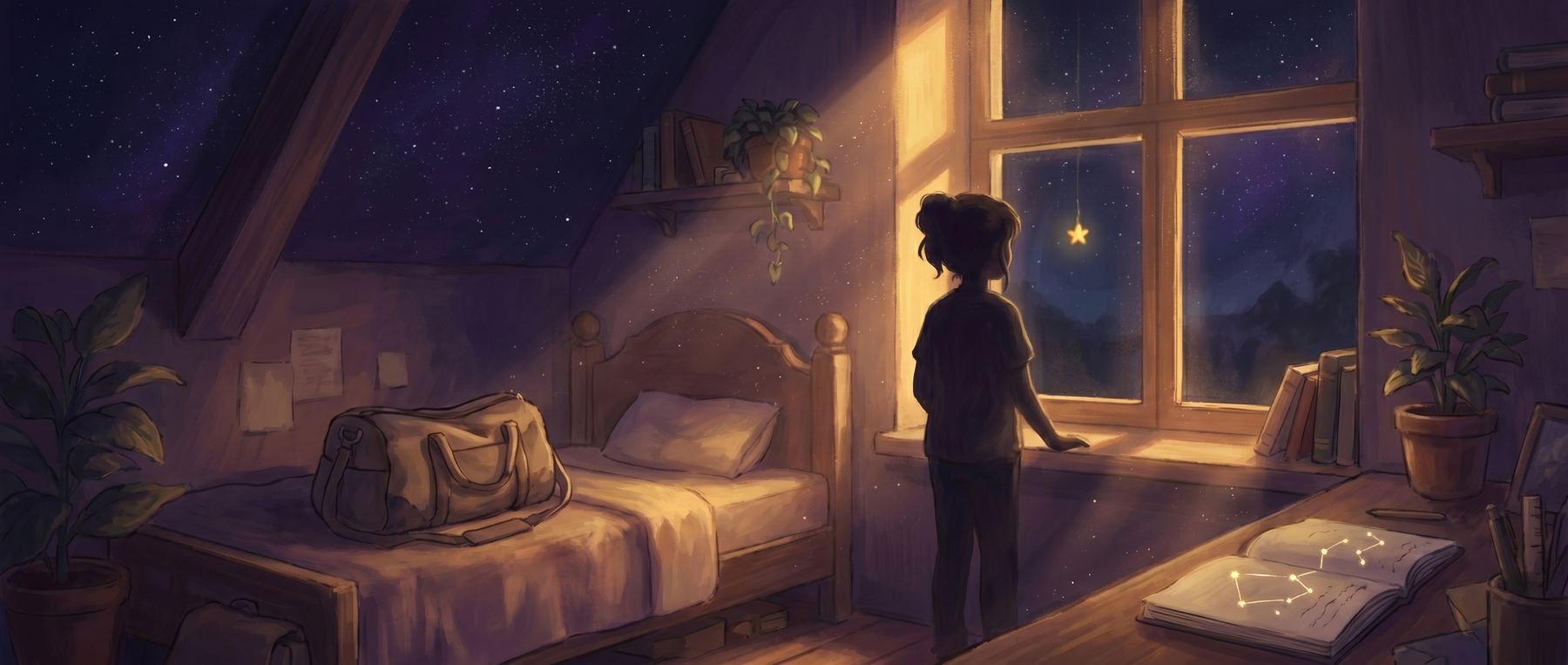
The duffel was army-folded on top of the locker, where it had lived for sixteen years, because she had never once unpacked all the way.
Kira packed in the dark of 217-B without deciding to. The survey kit. The charts that mattered, pulled from the wall in four efficient strips. The notebook, the spare pencils, the thermal layer, the med kit with the wraps. Her hands did it all from memory while the front of her mind ran the arithmetic in its native tongue, smooth as a beacon's lie: the heading is real, the shuttle is fueled, probation is already breached in every way that matters, the team is a chain of custody and chains are for evidence, you fly tonight, you fly alone, you lose nothing—
A flimsy of her mother's handwriting existed, and a friend had decided when she could read it. That was what people did. That was what people always eventually did — they ration you, they curate you, they decide what you can survive: the office, the institution, the professor, the friend, every single one of them holding a piece of her life and metering it out on their own clock, kindly, for her own good. Fine. Noted. Filed. You couldn't be metered if you were already gone. Dinner never lost anything it had promised her—
The light in the basin changed.
Kira turned, duffel strap in hand, and Shimmer was upright in the warming water — risen out of her coil, the dim prisms gathering, and the gray streak along her seam standing out like a fault line. And before Kira could say don't, before she could cross the room, her partner did the thing the medics had forbidden and the seam would bill her for: she sent.
One image. Small, costly, gray-toned at the edges where the winterburn ate the color, pushed across the muffled channel by raw will —
— a chart table. Seen from below, from a child's height, from underneath — the world reduced to table legs and the hem of a chart cover, and a small shaking shape folded into the smallest possible space, and then, into the frame of it, unhurried, a pair of knees. Someone sitting down on the floor. Within reach. Not reaching.
Her own memory. Leaked across a bond-vision at one day old, kept for three weeks in a being who hoarded textures like scripture, and spent now — at real cost, the seam's frost biting visibly down the channel — to show Kira the single load-bearing fact of her own biography:
The only person who ever did it right didn't pull her out from under the table.
He stayed where she could see him.
The duffel strap was still in her hand. The pain came through the channel in honest gray detail — sending had cost; the streak's edge had gone sharper; Yeun would have words — and under the pain rode the question-shape, the same one, patient as tide, turned outward this time and pointed at her:
still here?
Kira stood in the dark of her quarters between a packed bag and a hurt light, sixteen years of arithmetic on one side and three weeks of evidence on the other.
And then — small, absurd, unanswerable — her wrist tightened.
The moss cuff. Verdant's graft, alive on her arm since the mess hall, watered at the sink like a real promise. It pressed — not a squeeze, nothing so crude; a slow swelling hold, the way roots hold ground, and with it through some channel no instrument would ever find came a green patience that arrived not in her head but in her sternum, wordless, ancient, entirely unimpressed by the duffel: the register of a being whose whole self was the practice of staying somewhere and growing anyway. It did not argue. Roots don't argue. It held, the precise pressure of a hand on a shoulder, from forty meters away, on behalf of a girl who filed her cowardice under prudence and was sitting right now where Kira had left her, not following, not pleading her case, keeping the only vigil she thought she'd earned.
Stay is a place, the pressure said, in no words at all. I grow things back. Watch.
Kira looked at the duffel for a long time.
Then she put it down, and crossed to the basin, and laid her hand in the warm water beside the hurt light, palm up, the scorched-deck grammar, the oldest box they owned.
"That was the second-bravest thing I've ever personally witnessed," she said, voice wrecked, "and if you do it again before that seam heals, we are going to have words. Both meanings."
The prisms leaned into her palm. The metronome was nowhere in them.
Mira was still in the ready room.
She sat exactly where the table's geometry had left her, pad-less, hands folded, and she had clearly decided to wait there all night if waiting was the assignment — and beside her chair Verdant had returned, fronds settled, doing a thing Kira had never seen: holding one tendril lightly against Mira's splint-stiff wrist, the same grip as the cuff. Holding her ground for her. Orion was gone — tactful, or furious, or pre-fighting scenarios in a corridor somewhere; probably all three.
Kira pulled out the chair across from her and sat down. Within reach. Not reaching.
"Here's where the accounts stand," she said. The field-note register, but lower, and rebuilt, with the heat banked down where it would keep. "I'm angry. I'm going to be angry for a while — not performed angry, the real kind, the kind I don't have a procedure for. You took the one thing that was mine before it was evidence and you made it a holding. I'm not crossing that out. It stays on the page."
"It should," Mira said.
"And I'm staying."
Mira's breath caught — audibly, a footnote of a sound.
"That's the other entry, and it doesn't cancel the first one; they just sit on the same page now. I packed. You should know that — I packed in nine minutes, I had the strap in my hand, I was three corridors from doing the thing I have done my whole life. I'm telling you because you laid out your whole drawer, so here's mine: leaving first is my native language, and tonight I'm choosing to be bad at it." She put her wrapped hand flat on the table, halfway across. Not all the way. Half. "Half-forgiven, Chen. Earned forward, not granted back. The rest takes as long as it takes, and you don't get to ask after the schedule."
"That's—" Mira recalibrated, reflexively, even now. "That's more than the data supported."
"Yeah, well." Kira's mouth did something that wasn't a smile yet but had filed the paperwork. "I'm told the literature needs a new chapter."
Mira reached out — visibly asked permission of herself, qualifier by qualifier, and overrode each one — and set her hand on the table beside Kira's. Not touching. Adjacent. Two coordinates, one map. And in the corner of Kira's vision, faint and frameless and gone when she blinked, one bare line wrote itself across the night, no header, no tooltip, no explanation now or ever:
Kira read it, and let it go unchased — second one in three weeks; logged, never explained; counted by whom still standing in the notebook's margin like an open door — because Mira was talking again, and the voice had changed: the qualifiers were gone, and what was left was bare and fast, the headline at last unburied.
"I did something last night," Mira said. "Before the sequence. I want it on the record in the right order, so you know it wasn't penance — I did it first, then confessed, which matters procedurally." She retrieved the pad and opened it at speed. "The Beacon grid runs staggered maintenance windows — receiver arrays down for recalibration, four to eleven hours each, scheduled sector-wide. I pulled the next twenty days of windows and cross-laid them against your parents' true heading." The display bloomed: the sector, the lane, and threading through it a stitched corridor of gaps, dark window after dark window, a route drawn through the moments when nobody's instruments would be listening. "There's a seam through the dark. It's narrow, it moves, and it's flyable — if a pilot caught each window inside its margin, a ship could run that whole heading off the map and never once be read. I built it in six hours. I checked it three times." She looked up, terrified and steady at once, the proactivity arriving the way her sentences did — late, then all at once, then devastating. "Nobody sanctioned it. Nobody knew. I didn't ask the archives, or the Director, or you. It's the first thing I've ever made that no one gave me permission to make, and I'm not turning it in to anyone." She slid the pad to the table's center, where the chart of the swept lane still lay like a paid-off lie. "I'm offering it. There's a difference. I looked it up."
Kira looked at the route for a long moment — the seam through the dark, built unbidden by the girl who outsourced her own agency, aimed dead along her mother's true arrow — and felt the night's two entries settle side by side on their shared page, anger and staying, neither canceling the other, both true at once.
"It's a good seam," she said. "Best work on the table. Go get Orion — a route like that needs a crew that can catch windows, and we have a war to pack for."
✦ Chapter woven into the thread ✦
Next — Chapter 19: Preparing for War